How to drive a kart in the rain
In the rain, the fast way round is the smooth way round: leave the rubbered-in dry line, where the track is slickest, and brake earlier, steer and accelerate more gently than you would in the dry. Avoid kerbs and painted lines, and keep clear of the spray of the kart ahead so you can see.
Updated
Key facts
| Wet line | Off the rubbered-in dry line, where there is more grip |
| Inputs | Smoother and slower on brake, steering and throttle |
| Kerbs and paint | Very slippery when wet, avoid or cross gently |
| Braking | Earlier and lighter than in the dry |
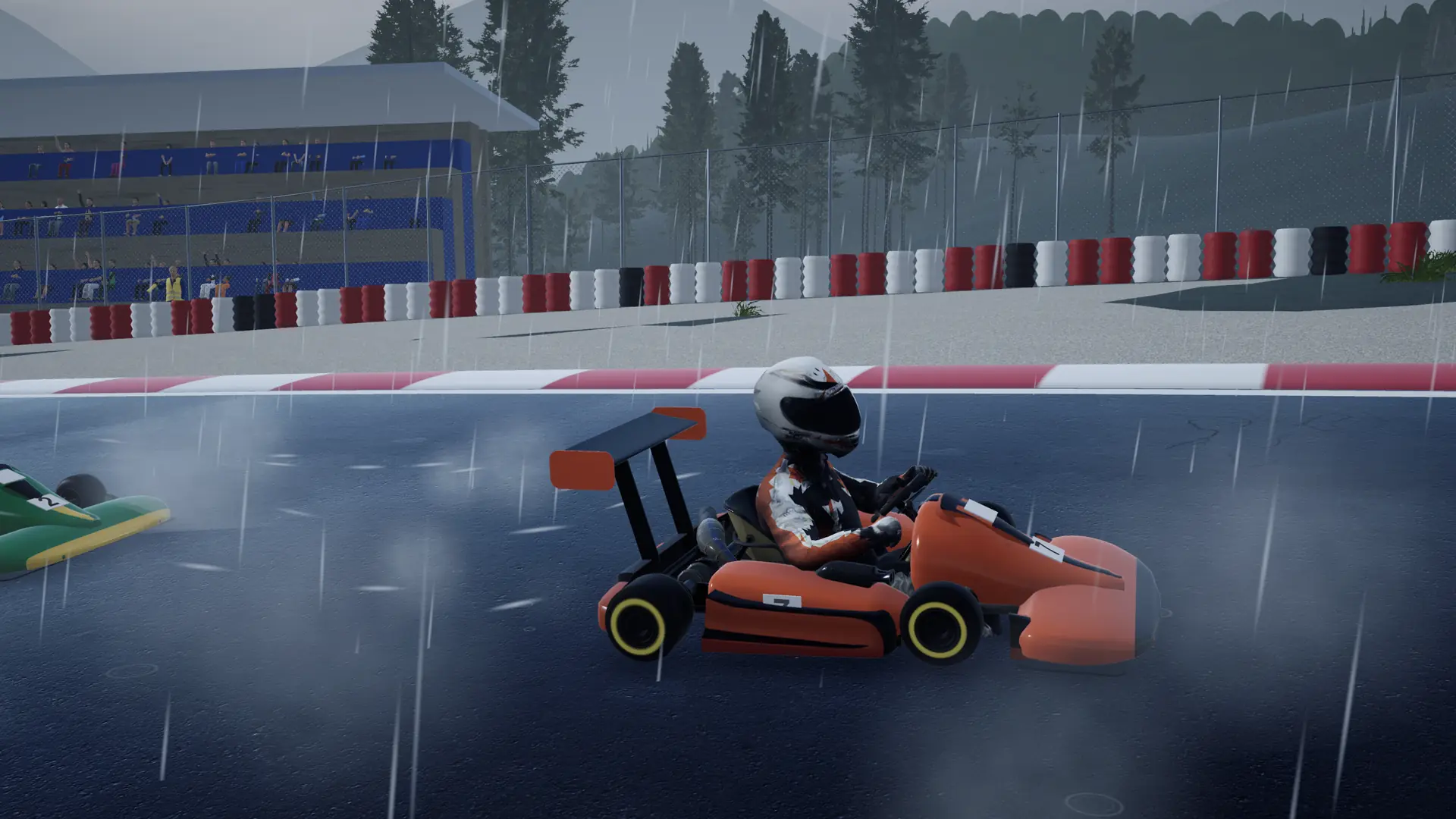
| In the game | Wet races in every class, spray, wet kerbs, rain on the visor |
Why the wet changes everything
A kart has no suspension, no differential and no electronic aids, so it tells you very clearly when grip is running out. In the rain the grip is lower everywhere, and it changes from one part of the track to another. The racing line of the dry is often the worst place to be, because rubber and dirt laid down by many laps mix with water and make the surface slick.
Finding the wet line
Off the rubbered-in line the asphalt is cleaner and usually grips better. In practice, try a slightly different path through each corner, often a rounder, less aggressive one, and compare how the kart feels. Avoid standing water, which can pull the kart sideways, and remember that the best line can move during the race as the track dries or the rain returns.
Smooth inputs
Every sudden input can break the tyres loose. Brake in a straight line and release gradually, turn in progressively and wait to straighten the kart before you open the throttle. On the exit, squeeze the throttle instead of stamping on it, because the rear can slide out as soon as you ask too much. Smooth is not slow: a clean wet lap beats a fast, scrappy one.
Kerbs and painted lines
Kerbs, painted lines, drain covers and any patch of paint are slippery when wet. Take less kerb than in the dry, and cross the white lines at the track edge gently and with the kart straight. A wheel on a wet kerb can unsettle the whole kart at once.
Seeing through the spray
The kart ahead throws up a cloud of spray that hides corners and braking markers. Stay a little further back than usual, or move to one side of the track so that you can see. Slipstreaming is less useful when you cannot see, so use it carefully. Learn the track in the dry so that you know where the corners are even when you cannot see them.
Braking earlier
Stopping takes more distance on a wet track, so start braking earlier than your dry marker and use less pressure at the start. Release sooner as well, so that the front tyres can turn in. If the kart still locks, you are asking too much: lift a little and try again with a gentler push.
Practise the rain in Real Karting
The career has at least one wet race in every class, with kerbs that turn to ice, spray that hides the kart ahead and raindrops on your visor. Start in the forgiving rental class, on a track you already know such as La Marina, and drive a few laps with the assists on. Then lower the assists, watch how the rubbered-in line shows where the dry grip is, and try other paths through the corners.
Start from the back of the 20-kart grid to practise driving in spray with the whole field ahead of you, and use the phone as a steering wheel in WHEEL mode to feel how small, smooth movements help. For real-circuit practice try Circuito de Pinto. Then read the guides on braking in a kart and race starts and overtaking.
Frequently asked questions
Is a kart faster on the dry line in the rain?
Usually not. The rubbered-in line gets slick when it is wet, so many drivers find more grip a little off it. Test it in practice, because it depends on the track.
Should I brake earlier in the rain?
Yes. Braking distances are longer, so start earlier than your dry marker, brake more gently and release sooner.
Are kerbs dangerous in the wet?
Yes, kerbs and painted lines are very slippery when wet, so use less of them and cross them gently.
How do I see in the spray of another kart?
Keep a little more distance or move to the side of the track, and learn the corners in the dry so that you know where they are.
 Free on iPhone, iPad & Mac
Helmet on. The grid is waiting.
Download Real Karting and turn your phone into a steering wheel.

 Coming soonGoogle Play
Free on iPhone, iPad and Mac. Android coming soon.