The racing line in karting: how to take a corner
The racing line is the path through a corner that lets you carry the most speed onto the next straight: brake in a straight line, turn in once, clip the apex late enough to unwind the wheel early, and let the kart run out to the exit kerb. A kart has no suspension and no differential, so every extra bit of steering scrubs speed, and a clean line is worth more here than in almost any other kind of racing.
Updated
Key facts
| The four points | Braking point, turn-in, apex, exit |
| Golden rule | Slow in, fast out: the exit matters more than the entry |
| Hairpins | Brake deep, late apex, point the kart straight early |
| Fast corners | Smooth and wide, little braking, one steady arc |
| Practise in the game | Rental 4T, ghost time trials, the line on the asphalt |
The four points of every corner
Every corner, from a tight hairpin to a flat-out sweeper, is built from the same four points. Learn to find them and you can read any circuit.
- Braking point: where you lift and brake, usually on the outside of the track, in a straight line. Pick a fixed marker (a sign, a change in the asphalt, a kerb) and move it a little closer each lap.
- Turn-in: the moment you start steering. One smooth, committed input is better than several small corrections.
- Apex: the point where the kart passes closest to the inside kerb. You aim for it, you do not stop there.
- Exit: where you are back on the throttle and the kart drifts out towards the outside kerb.
The usual shape is outside, inside, outside: use the whole width of the track on entry and exit so that the arc you draw is as wide as possible.
Why a late apex usually wins
If you turn in early and clip the apex in the middle of the corner, you have to keep the steering turned for a long time and you run out of road on exit. A late apex does the opposite: you turn in later, straighten the kart sooner and get on the throttle earlier. Because you spend more of the corner pointing along the next straight, you are fastest where it counts, all the way down it.
Hairpins versus fast corners
The technique changes with the speed of the corner.
- Hairpins and slow corners: brake deep, take a clearly late apex and get the kart straightened up as soon as you can. A lost tenth on entry costs far less than a messy exit onto a long straight.
- Fast corners: there is little or no braking, so the line is closer to a smooth geometric arc. Turn in progressively, keep the throttle as steady as the grip allows and avoid sudden steering, which makes a light kart slide.
Linking corners
Corners are rarely alone. Two corners in a row, an S-bend or a chicane have to be driven as one shape, and the golden rule is to sacrifice the first for the second: take a slightly slower, wider entry into the first corner so that you exit it in the right place and with the right angle for the next one.
Always ask which corner leads onto the longest straight. That is the one to protect. Everything before it can be a little slower if it makes that exit perfect, because you carry the extra speed for the whole straight.
Practise the racing line in Real Karting
The game is a good place to build these habits without risk. Start in the rental 4T class, the most forgiving kart, on a simple circuit such as El Parque. The AI rivals follow the ideal racing line of each track, and the rubbered-in line on the asphalt shows you where it is, so you can compare your own path with it lap after lap.
Switch on the time trials against your ghost to see exactly where you lose or gain time, and keep the assists on at first, then reduce them as your lines get tidier. Once the basics feel natural, move to a technical venue such as La Cumbre, where several corners link together. If you drive with the phone as a steering wheel (WHEEL mode), the smooth single steering input described above is easy to feel. Next, read the guide on braking in a kart, since the line and the braking point work together.
Frequently asked questions
What is the racing line in karting?
It is the path through a corner or a whole lap that lets you carry the most speed: wide on entry, close to the inside kerb at the apex and wide again on exit. Because it depends on the grip and the corner, it is a guide, not a fixed track.
What is a late apex?
Turning in later and reaching the inside kerb in the second half of the corner. It lets you straighten the kart earlier and accelerate sooner, which is usually faster onto the following straight.
Is the racing line the same in the wet?
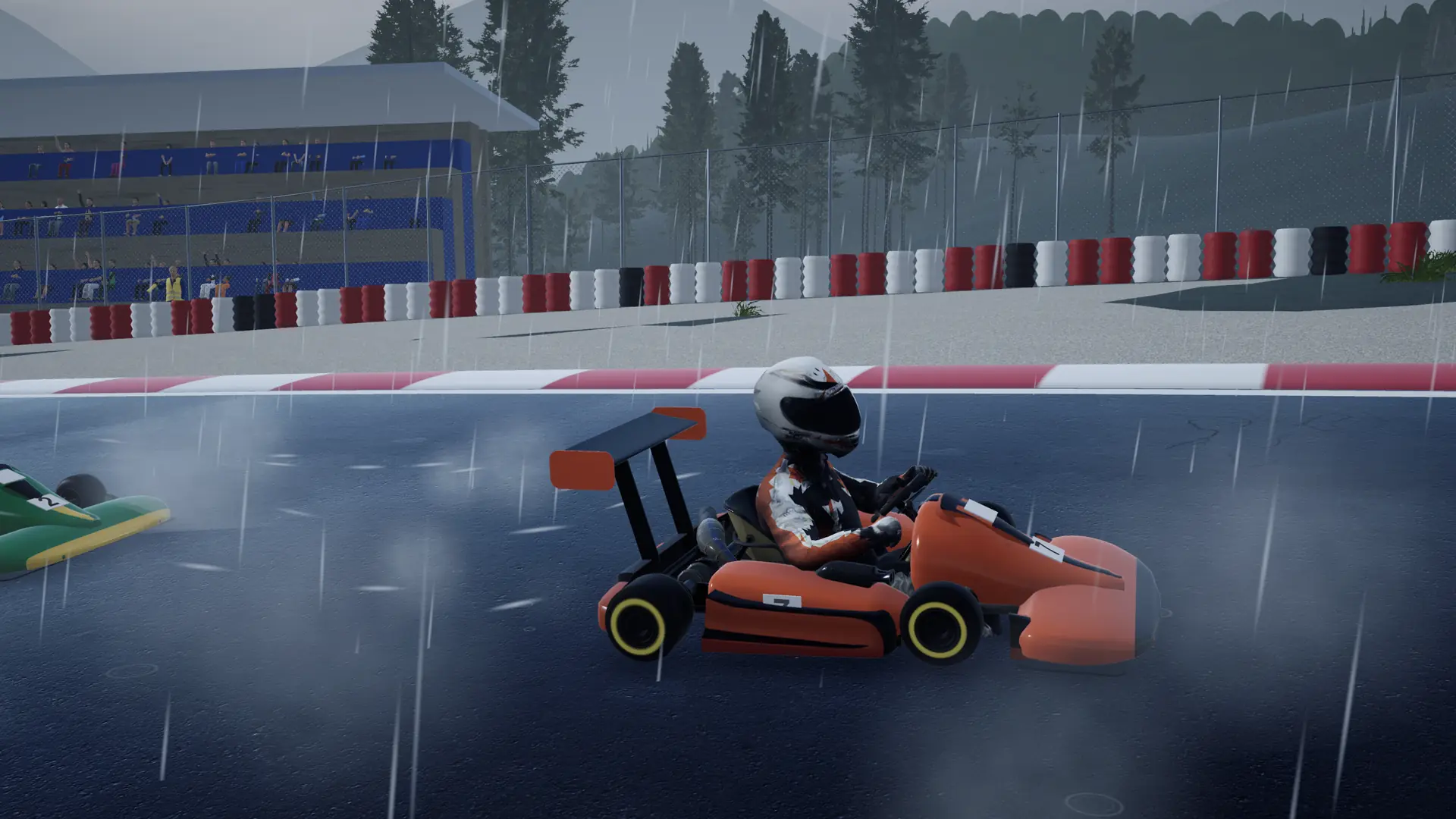
No. When it rains the normal line is often slippery, so drivers move off it. See the guide on driving a kart in the rain.
 Free on iPhone, iPad & Mac
Helmet on. The grid is waiting.
Download Real Karting and turn your phone into a steering wheel.

 Coming soonGoogle Play
Free on iPhone, iPad and Mac. Android coming soon.